
The Words We Use: Designing the Energy of the Dental Day
Why a single phrase in your morning huddle can shape clinical performance, team energy, and patient experience.
I say that from experience. I’ve used the wrong words. I’ve framed days in ways that created unnecessary pressure. I’ve unintentionally introduced stress into an environment that depends on clarity and precision. Over time, I’ve learned something important—language is not passive. It is directional. While I don’t get it right every time, I’ve become far more intentional with the words I choose, and the impact on the day is undeniable.
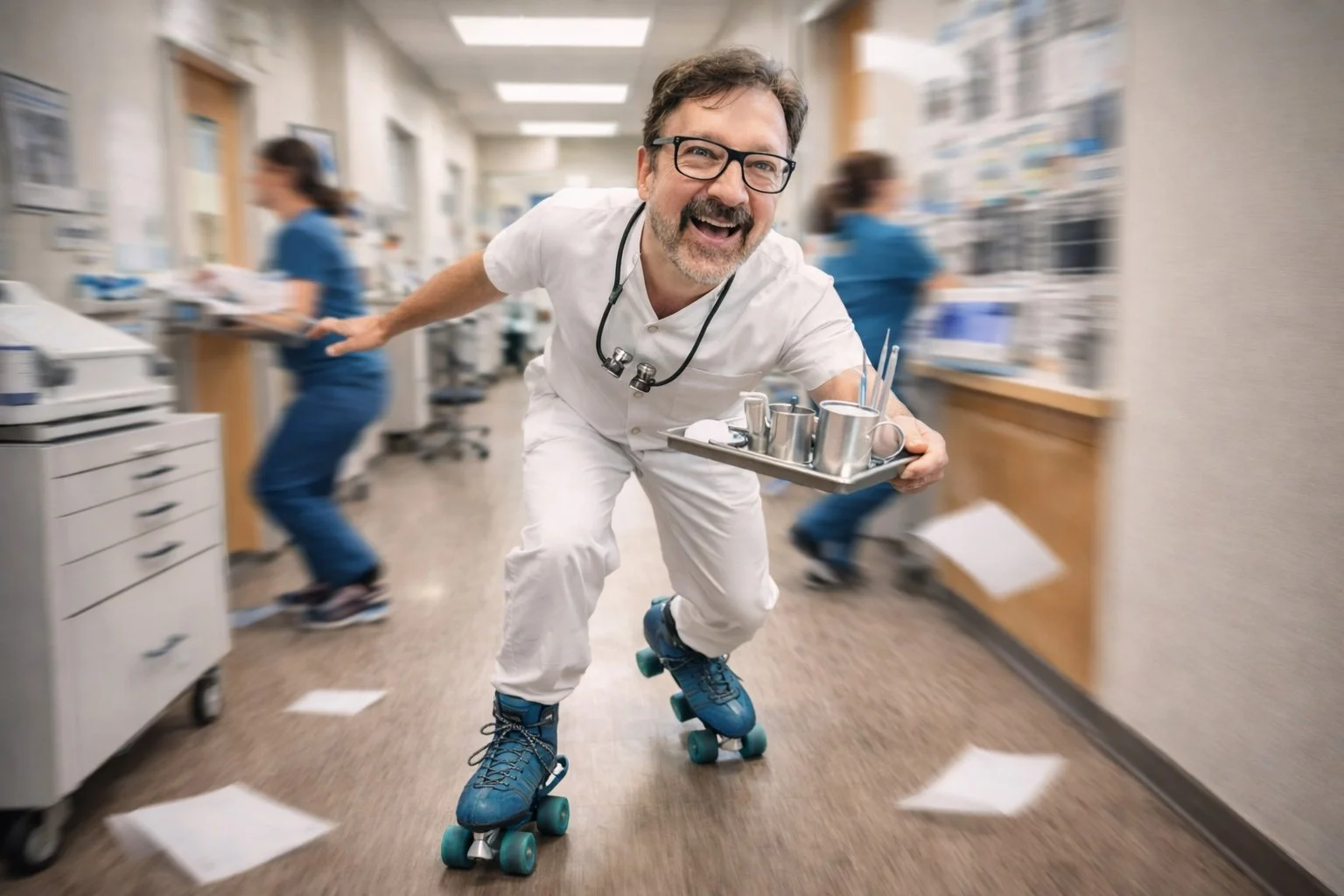
This morning, a simple phrase surfaced in the office: “We’re on roller skates today.” On the surface, it sounds harmless—even productive. It suggests movement, efficiency, and a full schedule. But embedded in that phrase is a different signal. It could imply instability, a lack of control, and the expectation that the day may feel chaotic. And the moment that phrase is spoken, something subtle begins to shift internally.
Words are not neutral—they are instructions to the nervous system.
In dentistry, we operate in an environment that requires precision at every level. We think carefully about margins, materials, occlusion, and calibration. Yet we often overlook one of the most powerful variables influencing our performance: the language we use. The words spoken in the morning huddle don’t just describe the day—they begin to define it. They shape how the team anticipates the workload, how we move between patients, and how present we are in each interaction.
When the brain hears a phrase like “roller skates,” it begins to prepare for speed without full control. It anticipates increased cognitive load and a higher likelihood of things getting away from us. Even a small increase in internal stress can affect how we communicate, how we think, and how we perform clinically. Conversations become shorter. Transitions feel rushed. Decision-making becomes less clear. The tone of the day shifts before the first patient is even seated.
The goal is not to deny the reality of a full schedule. A busy day is a busy day. The goal is to define that reality in a way that supports performance instead of undermining it.
There is a clear difference between language that creates instability and language that creates mastery. Phrases like “we’re slammed,” “it’s going to be crazy,” or “let’s just get through the day” prepare the team to survive. In contrast, language such as “we have a high-performance schedule today,” “this is a well-orchestrated day,” or “we’re moving in a strong clinical rhythm” prepares the team to execute. The schedule hasn’t changed—but the experience of it has.
This concept closely mirrors what we already understand in digital dentistry. When we design 90 to 95 percent of a restoration virtually, the milling process becomes clean, predictable, and efficient. When we don’t, we spend time adjusting, refining, and reacting. The same principle applies to the structure of the day. If the day is not designed linguistically, it will be adjusted emotionally.
Patients, whether we realize it or not, are highly perceptive to this difference. They don’t just evaluate the quality of dentistry—they feel the energy of the environment. They sense pace, tension, and presence. If the internal narrative of the team is “we’re just trying to keep up,” patients feel rushed, even when the clinical work is excellent. But when the narrative shifts to one of purpose and precision, patients feel cared for, prioritized, and confident in the treatment they are receiving.
As the leader of the practice, your words function as a control system. Just as you would never ignore calibration in a milling unit or accept discrepancies in occlusion, you cannot afford to allow unstructured language to define your day. The words you choose in the morning set the tone for everything that follows.
A simple reframe can make a significant difference. Instead of saying, “We’re on roller skates today,” consider saying, “We have a full and well-aligned schedule today. Let’s stay in rhythm, communicate clearly, and take each patient with intention. If we do that, the day will flow.” This approach acknowledges reality, establishes control, and defines a clear outcome.
High-performing teams are not just clinically skilled—they are linguistically disciplined. They eliminate phrases that introduce instability and replace them with language that reinforces structure, clarity, and confidence. Over time, this becomes part of the culture.
The implementation is straightforward. Begin by identifying default phrases that create unnecessary stress—words like “crazy,” “slammed,” or “behind.” Replace them with intentional language such as “aligned schedule,” “strong flow,” and “precision pacing.” Most importantly, reinforce this consistently. Language must be modeled and repeated to become embedded.
In dentistry, we design outcomes before we execute them. We should approach our days the same way.
Words are not commentary—they are architecture.
A schedule is never just a schedule. It is either a sequence we struggle to manage or a system we are prepared to execute. And often, the difference begins with a single phrase.
Tomorrow morning, try one simple change. Replace “roller skates” with “rhythmic flow,” and observe what happens.
About the Author
Dr. James Klim brings more than 40 years of clinical experience to dentistry, guided by a deep passion for patient care and authentic human connection. Over the course of his career, he has taught and lectured internationally on topics including digital restorative dentistry, aesthetic dentistry, patient communication, and the importance of authenticity within a practice.
He is widely known for his cinematic tutorials that walk clinicians step by step through digital dentistry procedures, helping make complex clinical concepts more understandable and practical. Beyond the technical side of dentistry, Dr. Klim genuinely enjoys connecting with other doctors and discovering what drives them, both professionally and personally.
What motivates him most as an educator is the opportunity to share the lessons he has learned through life and practice so others can move forward with greater efficiency, clarity, and purpose. For Dr. Klim, the greatest reward is what he can leave behind in the lives of others—helping them build not only better skills, but a better life.